Liquid-Solid Separation Equipment
Each separation challenge calls for its own solution, and this is where we excel. Compatible Components Corporation’s liquid-solid separation equipment spans multiple mechanisms and materials of construction, from centrifugal hydrocyclones for continuous high-volume slurry processing to portable gravity-drain hoppers for on-site dewatering. We provide solutions for various industries, including oil and gas, mining, environmental remediation, and chemical processing.
Separation and Dewatering Solutions for Every Process Condition
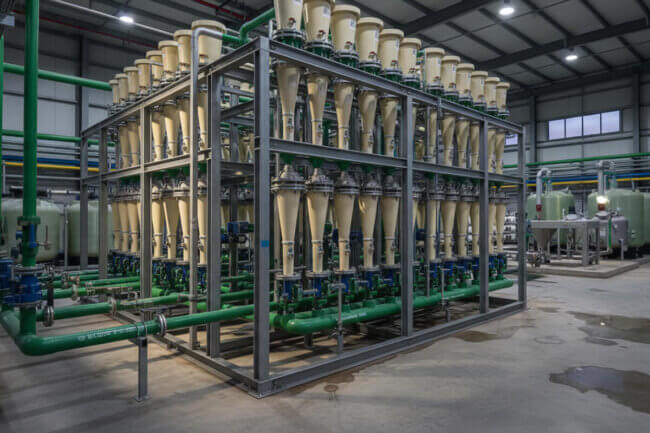
When it comes to industrial separation solutions, the right choice involves matching the mechanism to what you’re separating, at what throughput, and in what environment. The same slurry that works well in a hydrocyclone in one application might call for a gravity-drain hopper in another. CCC has been building separation and dewatering equipment since 2001, with worldwide installations for oil and gas, mining, environmental remediation, chemical processing, and food and beverage industries. Our products cover a range of approaches so you can match the method to your process conditions.
Request a QuoteOur Separating + Dewatering Products
CCC’s separating and dewatering line includes two hydrocyclone options in different materials of construction, a self-dumping dewatering hopper, and a multi-phase separator. Each is designed for a different set of process conditions, so the best starting point is understanding what mechanism fits your application.
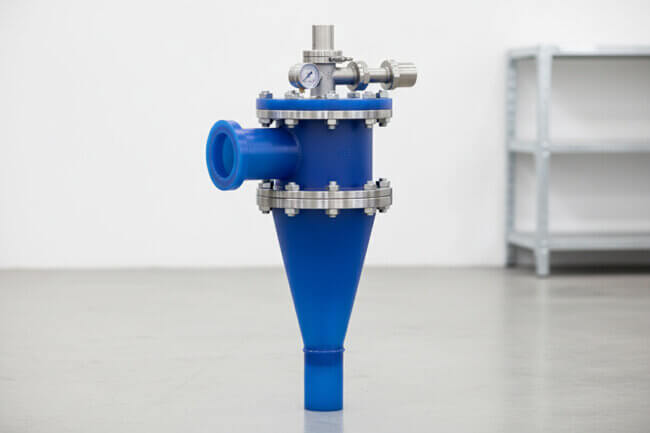
Urethane VorSpin Hydrocyclones
The Urethane VorSpin Hydrocyclone is the right call when abrasion is a concern. This centrifugal separation equipment converts feed pressure into rotational energy, which drives heavier solids toward the cyclone wall, while the cleaned liquid exits through the overflow.
Three design features separate it from conventional hydrocyclones: a volute feed inlet that prevents the incoming slurry from circulating back on itself, a fluted Vortex Finder that accelerates separation and keeps larger particles from short-circuiting out with the liquid phase, and a non-plugging Apex discharge with a lobed orifice that keeps the underflow clear even under high solids loading.
Urethane VorSpin Hydrocyclones see regular use in sand and silt removal, drilling fluids processing, dredging, and mineral classification.
Stainless Steel VorSpin Hydrocyclones
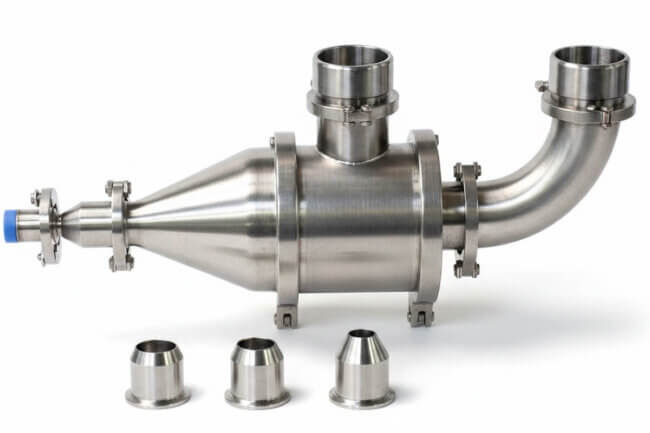
When the process fluid would degrade urethane, or when food-grade or corrosion-resistant materials are required, the Stainless Steel VorSpin Hydrocyclone delivers the same volute inlet, fluted Vortex Finder, and non-plugging Apex as the urethane model, built in 304 stainless steel.
It’s a no-moving-parts separator, with no electrical connections and no rotating components, which keeps maintenance simple and reduces the number of things that can go wrong mid-run.
Performance charts are available for each model size, and manifold configurations let you scale capacity without changing equipment.
AZ Self-Dumping Dewatering Hoppers
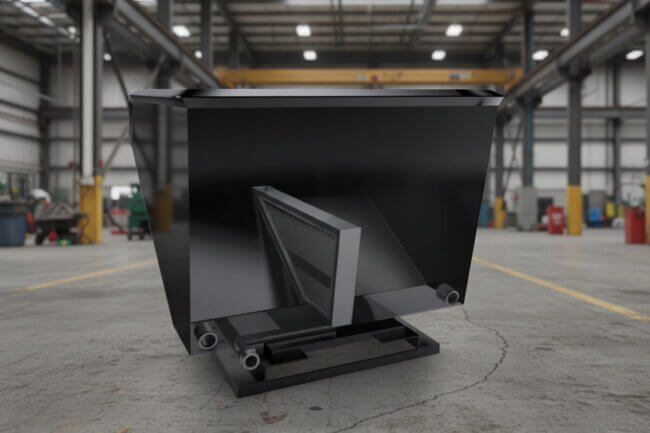
When you need solids removal equipment that goes to the material rather than the other way around, you need the AZ Self-Dumping Dewatering Hopper.
Sludge or slurry transfers directly into the portable hopper and starts draining immediately through two vertical filter panels. Vertical orientation is intentional; vertical panels don’t blind off the way horizontal filter media does, which keeps drainage moving.
Connecting an air diaphragm pump to the drainage port below the safety latch speeds up the process and sends the separated liquid wherever it needs to go. When dewatering is complete, a forklift moves the hopper for dumping.
Filter panels are replaceable and come in a range of micron sizes.
Applications
CCC’s separation and dewatering equipment is essential in many industries and process scenarios. The application areas below represent the most common uses for this product line.
- Oil and Gas/Petrochemical: Produced water treatment, drilling fluids-solids control, catalyst recovery, and produced sand management.
- Environmental Remediation: Groundwater treatment and sludge dewatering for waste minimization.
- Mineral Mining and Dredging: Classification and removal of sand, silt, and coarse particles from process water and slurries.
- Chemical Processing: Separation and recovery of suspended solids from process streams in refineries and chemical plants.
- Food and Beverage: Stainless steel equipment for sanitary, corrosion-resistant separation applications.
- Drilling Fluids Management: Solids control and reclamation in drilling operations, onshore and offshore.
- Soil Washing: Separation of contaminated particulates from soil-water slurries in remediation projects.
Find the Right Liquid-Solid Separation Equipment for Your Process
If you want to talk through which liquid-solid separation equipment fits your production needs, CCC’s team can help you get there quickly. Just give us a shout or shoot us an email. Our Pilot Study Program lets you run the equipment in your own process before buying, which takes a lot of the guesswork out of equipment selection.
FAQs: Liquid-Solid Separation Equipment
What’s the difference between the urethane and stainless steel VorSpin Hydrocyclones, and how do I choose between them?
Both models use the same VorSpin design, so separation performance is comparable. The choice is really about material compatibility. Urethane holds up better against abrasive solids (sand, silica, and drill cuttings) where stainless steel would wear faster. Stainless steel is the right choice when the process fluid would attack urethane, or when you need food-grade materials or corrosion resistance.
How does the VorSpin MultiPhase Separator differ from a conventional hydrocyclone?
In a conventional hydrocyclone, two opposing vortices form inside the body: one spiraling down toward the solids underflow, one spiraling up toward the liquid overflow. Those opposing flows create a zone where particles can exit through the wrong outlet, limiting how cleanly you can separate phases. The VorSpin MultiPhase Separator uses a single, unidirectional vortex. The slurry enters one end; all separation occurs at the other; and each phase exits its own outlet without interference from opposing vortex flow. That design is also what makes it capable of separating oil, water, and solids simultaneously, something a conventional hydrocyclone is not set up to do.
What particle size range can the VorSpin Hydrocyclone separate?
Cut point (the particle size at which 50% of particles report to the underflow) depends on cyclone body diameter, feed pressure, slurry density, and the gravity difference between the liquid and solids. Smaller-diameter cyclones achieve finer cut points but handle less volume per unit. For higher throughput or finer separation, multiple cyclones run in a manifold. CCC provides dimensional and performance charts for each VorSpin model size, and the Pilot Study Program is available if your targets are tight or your slurry does not fit a standard profile.
Can CCC’s hydrocyclones separate liquid from liquid, or only solids from liquid?
The standard VorSpin Hydrocyclones provide solid-liquid separation (removing suspended solids from a liquid carrier). Liquid-liquid separation, such as oil from water, requires a meaningful density difference between the two liquid phases and is what the VorSpin MultiPhase Separator is built for. If you’re dealing with a mixed-phase stream and are not sure which product applies, CCC’s team can work through the gravity conditions with you to identify the right fit.